


You’re doing it again.
You’ve got the route pulled up on your laptop. Maybe it’s the Pacific Coast, maybe it’s the Danube, maybe it’s just a two-week loop through your home province that you’ve been meaning to ride for years. The panniers are in the closet. The bike is tuned. And you’re sitting there, scrolling through training plans, thinking: I’ll leave when I can comfortably ride a century.
Here’s what happens next. Six months become eight. Eight becomes “next spring.” Next spring becomes “once the kids are older,” or “after this project at work,” or some other perfectly reasonable excuse that sounds nothing like fear but smells exactly like it.
I’m not here to shame you. I’ve done this too. But I am here to tell you something that took me far too long to learn: there is no such thing as ready. There is only gone.
And here’s what nobody tells you: the body figures it out fast. It’s the mind that takes longer to catch up.
Your body is smarter than your training plan
The specific fitness required to ride a loaded bike six hours a day across varied terrain cannot be built in your basement on a smart trainer. It cannot be built on Sunday group rides where you stop for coffee and complain about the weather. It can only be built by riding a loaded bike six hours a day across varied terrain.
There’s a principle in exercise science called Specific Adaptation to Imposed Demands—SAID, for those who like acronyms. (I had to look that up years ago; it’s not the kind of thing you learn on the road.) Your body becomes capable of exactly what you ask it to do. Not what you wish you could do. Not what you plan to do. What you actually, physically, repeatedly do.
This is why marathon runners can be destroyed by bike tours. Why gym rats with massive quads struggle to ride fifty kilometres with bags. Fitness is not transferable currency. You cannot deposit leg presses and withdraw hill-climbing endurance.
But here’s the beautiful part: the adaptation happens fast. Faster than you’d believe if I just told you.
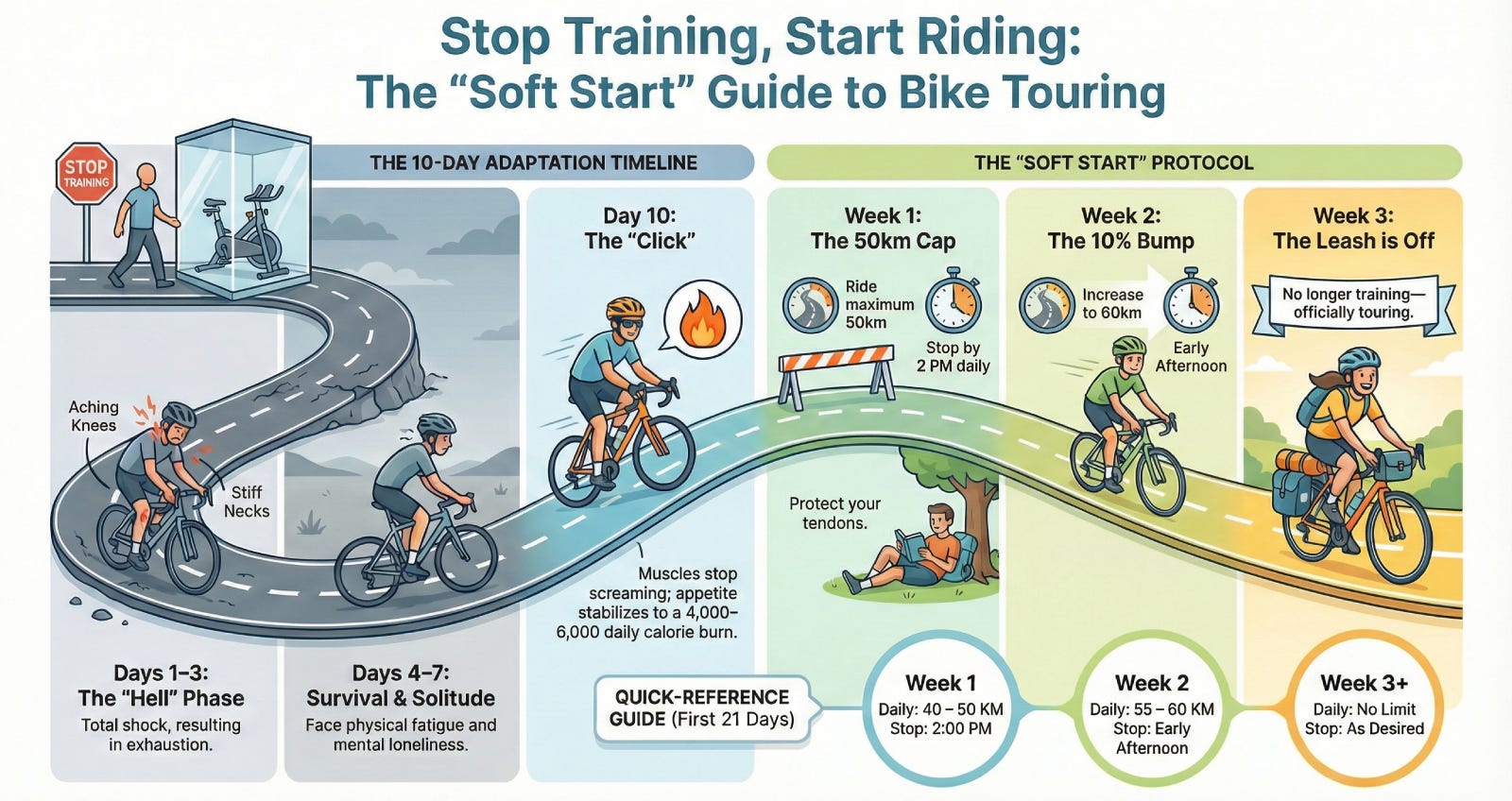
The first three days will be hell. Your knees will ache. Your neck will seize up from holding your head at an angle it has never held before. You will question every decision that led you to this moment, starting with the day you first learned to ride a bicycle. You will eat dinner at 5:30 PM and be asleep by 7.
Then comes survival mode, days four through seven. You wake up tired. You ride anyway. You eat constantly and still feel hollow. Your body is burning through reserves it didn’t know it had. This is also when the loneliness hits. The novelty has faded. You’re left alone with your thoughts, and your thoughts are not always kind.
And then, somewhere around day ten, something clicks.
Your legs stop screaming and start simply working. The appetite finally catches up to your caloric burn rate—somewhere around 4,000 to 6,000 calories a day, which sounds absurd until you’re living it. Your hands have developed calluses. Your sit bones have surrendered. Without meaning to, you have become a professional athlete because you are now training forty hours a week.
This transformation was always available to you. You just had to leave to trigger it.
The catch that ends tours early
Leaving untrained doesn’t mean leaving stupid. The mistake that ends trips early isn’t weak legs—it’s inflamed tendons. And tendons don’t care about your motivation. They care about volume.
If you leave the couch on Monday and try to ride a hundred kilometres on Tuesday, you will develop tendonitis by Thursday. Your Achilles will swell. Your knee will click ominously. You will limp into some small town and spend a week in a hostel, icing your joints and cursing your enthusiasm.
So here’s the protocol. Call it the Soft Start.
Week one: cap yourself at forty to fifty kilometres per day. No exceptions, no matter how good you feel. Stop riding by 2 PM. Sit in a café. Read a book. Treat this like a vacation, because right now, it is. Your body is adjusting to stresses it has never experienced—and so is your mind.
Week two: increase by ten percent. Fifty-five kilometers. Maybe sixty. Still stop early. Still prioritize rest.
Week three: take the leash off.
By now, your tendons have caught up. Your muscles have adapted. The hell phase is behind you. You’re not training anymore—you’re touring.
The only difference between this approach and a “real” training block is the scenery. You can suffer on a stationary bike in your garage, staring at a concrete wall, or you can suffer on a coastal road in Portugal, watching the Atlantic crash against cliffs. The adaptation is the same. The experience is not.
What actually kills a tour
I’ve watched riders quit. Not many, but enough to notice the pattern.
The ones who go home early are rarely the ones who can’t keep up physically. They’re the ones who can’t handle the uncertainty. The rain that won’t stop. The headwind lasts for days. The loneliness that settles in around day four when the novelty fades, and you’re left alone with your own thoughts.
An out-of-shape rider with a stubborn mind will pedal around the world. I’ve seen it. Meanwhile, I’ve watched racers—actual competitive cyclists with legs like pistons—quit the moment conditions turned ugly.
You can arrive at the start line with a VO2 max that would impress your doctor, and still be destroyed by a sore neck, numb fingers, and three consecutive days of rain. The body parts that fail on tour are not the ones you train at the gym. They’re the small, forgotten connectors—the tendons, the stabilizers, the bits of cartilage you’ve never thought about. And the part of you that fails first? Usually isn’t physical at all.
You don’t need to train your legs. You need to train your ability to sit with discomfort. To wake up tired and get on the bike anyway. To accept that today will be hard and tomorrow might be harder—and to want it anyway.
That training doesn’t require a gym membership. It doesn’t require a power meter, a coach, or a structured sixteen-week plan. It requires only a willingness to be uncomfortable—and you can start practicing that right now, today, regardless of your current fitness level.
The only fitness test that matters
Picture yourself two weeks from now. You could be at home, still “preparing,” pedalling nowhere on a trainer in your garage while watching YouTube videos of people who actually left.
Or you could be five hundred miles away, sitting in a small-town restaurant, shovelling pasta into your face, legs pleasantly empty, body already stronger than it was when you started.
If you have the bike, the bags, and the money, go.
The road will build the legs. It’ll build the lungs. Everything you think you need to build first? The road handles that.
You just have to trust it enough to leave.
This gives you the philosophy. For the rest—the gear, the route planning, what to do when your derailleur snaps forty kilometres from nowhere, there's Train, Pack & Ride. The mindset gets you out the door. The details keep you on the road.
This piece first appeared on the Cycle Touring Life Substack, where a new letter from the road goes out every week. Subscribe here.
When you decide to stop preparing and go: the touring bundles cover the gear question in one decision, and our FAQ answers the rest.